
A Sprig of Myrtle
An Excerpt with Epilogue from the Forthcoming Book
John Shelby Hadden
“Doc, you’re a good man. There’s just no demand anymore.” What did that mean? Especially to a fourteen year old freshman still navigating puberty with the quite fetching feminine beauty of Farrah Fawcett and Daisy Duke.
Was I good?
Barbasol was overkill for my peach fuzz. I needed rides home. Fast cars and freedom were still on the horizon. So even the notion of manhood seemed a bit premature.
But a good man? Now that’s a weighty matter for sure. Doc, you’re a good man. There’s just no demand anymore. Digesting these words was like chewing a bite of steak with fatty tissue. Getting to the swallow point was elusive. Was this a compliment? I was Doc. The coach was addressing me. And he was not cutting me from the basketball team as we wrapped up practice down the road at the Boys Club gym since the varsity squad, the big men on campus, had first dibs at West High. Just a flippant remark in passing. That’s all.
In these here parts, we call a son the spittin’ image of his father if they’re a lot alike. I used to think the expression spittin’ image had something to do with spitting, but then I learned in a book How to Speak Southern—I flipped through it once at Cracker Barrel—that it means the spirit and image. But in the South we kinda run our words together so that spirit and image comes out spittin’ image. Maybe that’s what Coach had in mind. He knew dad. Everyone did. Painless Joe, the best dentist in East Tennessee. A good man. And anywhere he went in town, it was “Hey Doc.”
Or maybe Coach overheard my teammates and friends calling me Doc, but not on account of my dad’s profession. Dr. J was my hero. As in Julius Erving, the subject of my middle school book report. I was a playground All-American, twirled the ball for the Little Big Orange Basketeers during the double trouble from Tennessee days of Ernie and Bernie, and could glide through the sky with a pirouette finger roll. Back in middle school for the Lincoln Heights Patriots, I once strapped on my red, white, and blue head band, wrist bands, and blue knee pads, only to sit on the bench the whole game. But I’m sure I looked like the NBA icon during warm ups.
Words are curious things. And the source from whence they come matters. I mean a basketball coach may serve up and foreshadow the lies of chaos. But those need not be the final words that shape a search for significance. Words can be formative. Defining. Especially when hearing them, coupled with meaningful touch, from an anointed source like Simeon, an elderly, righteous man who met Joseph and Mary in the temple, took their newly born son in his arms, and spoke forth a dramatic and well-appointed future: Behold, this Child is destined for the fall and rise of many in Israel, and as a sign to be opposed— and a sword will pierce your own soul—to the end that thoughts from many hearts may be revealed. As Joseph processed this prophecy, his heart could have been throbbing with an even more ancient blessing of the patriarch Jacob, who spoke over his son: Joseph is a fruitful branch, a fruitful branch by a spring; its branches hang over a wall. The archers provoked him, and shot at him and were hostile to him; but his bow remained firm, and his arms were agile, from the hands of the Mighty One of Jacob, from there is the Shepherd, the Stone of Israel, from the God of your father who helps you, and by the Almighty who blesses you with blessings of heaven above, blessings of the deep that lies beneath, blessings of the breasts and of the womb. The blessings of your father have surpassed the blessings of my ancestors up to the furthest boundary of the everlasting hills; may they be on the head of Joseph, and on the top of the head of the one distinguished among his brothers.
At fourteen, if I had ever come across such framework laid by Simeon or Jacob—at best the lector bounced these words off the sanctuary walls at First Presbyterian one Sunday morning while a little boy tried to behave, or the adults in the living room discussed something of the sort as a youngster eavesdropped from the stairs in the foyer—they were nowhere near as an antidote to: Doc, you’re a good man; there’s just no demand anymore. And an antidote, even if I didn’t know it then, must have been what I was looking for. I mean, flippant or not, they left a mark. Enough of a mark to bring them up at supper one night. With our patriarch sitting at the head of the table, I relayed what the coach said. Crestfallen and somewhat miffed, daddy said, “He said that? He shouldn’t say that.” Daddy didn’t like those lying words.
But what to say instead, I never heard. Daddy worked well with his hands. His workmanship was crafted with conscience. With inner voice. And the work product spoke for itself, whether casting crowns in the lab; trimming hedges for curb appeal; tying a Windsor Knot for the finishing touch of the Brooks Brothers suit; carving a Pinewood Derby red-striped racer; spit-shining the wingtips; or polishing the Porsche. It was sharp. Very sharp. The ivy crawling up the brick walls of our house on Darbee Drive was well-manicured, mostly by dad, but he would also give some odd jobs, like pulling the poisonous three-leaved creeper, to Tommy, a local wino who claimed he could extract it bare-handed with no ill consequences. Tommy even bragged of sexual escapades lying in markweed; said it never bothered him, but I never heard if his consort ended up itching with a rash. Nonetheless, the random day laborer left with enough folding money to buy another bottle of booze and our landscaping was ready for Southern Living to stop by. Little did I know the Vine of Sodom was crawling like kudzu through our culture, but the street view at my homeplace was Ivy League sharp, button-downs and all. So when a 29 year old lieutenant left the gooney birds on Midway Island for private practice, he might as well be meeting the Commander in Chief. Rather, it was Dr. Will Baker’s estate lawyer. A firm handshake in his Navy Whites closed the deal with a first impression. The Haddens were settling in Morristown in 1967.
There is a sense of place in East Tennessee. And I kind of think dad added to the natural beauty of the rolling hills in the valley between the Clinch Mountains coming down out of Kentucky and Virginia and the Great Smoky Mountains bordering North Carolina. Farmlands and rivers created pastoral scenery that made me wish life could linger. The Tennessee Valley Authority damned up our rivers to make lakes. Our politics weren’t as strong as Knoxville, so in the off season, the not-so-great lakes went back to being rivers. But I didn’t mind back then. We took our motorcycles down to the lake bottoms—they made for good dirt bike ridin’. Industry came in too. I used to hear a strong work ethic attracted companies. Way out by the interstate, American Enka’s chemicals put out an offensive stench that militated against nature, but only passers-by smelled it. Up in Kingsport, the Eastman Kodak company took a leak in the Holston River once. It was so bad, we made the national news downstream in Morristown. They came down and interviewed Mayor Z Buda. Asked him about the Holston River water. He said, on national news: “the water tastes so bad around here, a dog has to lick his hind end just to get the taste out of his mouth.” That was our cameo on national news. “And that’s the way it is…” Walter Cronkite signed off for the evening. Not only is it beautiful here, so were the people. For grammar, I should probably say so are the people. For verb tense agreement. But I’m reflecting back fifty years, and it’s a little, well, more confusing these days. Back then I remember lots of salt of the earth folks. Problems for sure. But good folks. The kind that lined Main Street for Christmas parades and all that; I rode with dad in his antique Model A under the garland lights of the downtown overhead sidewalks packed with festive crowds waving with the puttering engine and the ooooga horn. Small towns have that feel. And dad’s aesthetic enhanced it. He added Williamsburg architecture to West First North Street, the destination to and from which he walked to work—wingtips, coat and tie—for over four decades. And walked fast. And worked hard. From dawn to dusk. From can ’til can’t. If someone pulled up to offer him a ride, he would smile and decline, “Thank you, but I’m in a hurry; I think I’ll just walk.”
“My dad’s name is Joseph and my mom’s name is Mary. Other than that, I’m not anything like Jesus.” That’s what I told my classmates at Dallas Theological Seminary years later when the professor had each of us break the ice with something interesting about ourselves. Jesus was good. There’s a good man. But even he deflected the notion. A rich, young man ran up to Jesus and knelt before him, addressing Jesus: Good Teacher. His version of Doc, you’re a good man. But Jesus said, why do you call me good? No one is good except God alone. Try digesting that one.
Listening to Jesus teach reminds me of the story of legendary coach Vince Lombardi relayed by author David Maraniss: He took nothing for granted. He began a tradition of starting from scratch, assuming that the players were blank slates who carried over no knowledge from the year before… He began with the most elemental statement of all. “Gentlemen,” he said, holding a pigskin in his right hand, “this is a football.”
And I feel like the player who needs to raise his hand, “Coach, not so fast.”
No one is good except God alone. He began with the most elemental statement of all. Whatever Jesus intended in this most elemental statement, I knew full well that other than being called the son of Joseph and Mary, I was nothing like Jesus. And I was the one that fell into the no-one-is-good-except-God-alone-catch-all-bucket.
One Little, Two Little, Three Little Haddens. That was the caption of the photo in the Citizen Tribune that introduced Mrs. Joseph L. Hadden with her three chicks in the nest. Mother Mary; Joe, born first in 1962; yours truly, John Shelby, conceived like the Mustang in ’64 and a half, born like the Shelby in ’65; and our baby sister Becky born in 1967. And if momma could have frozen time, she would have picked the early 1970s snuggling with her three jam-a-lambs at 1479 Darbee Drive. She didn’t like the women libbers taking out the r of Mrs. By all appearances the Haddens were a patriarchy. The weekly liturgy included the Our Father. At church, we prayed for His Kingdom to come. You wouldn’t know it these days, but heaven is still a patriarchy, and through it, Our Father provides and protects. Abba Father, from whom every family in heaven and on earth derives its name. Editors hostile to the patriarchal language of His Word have a lot of work to do. It’s a project fraught with perilous consequences. Yes, Heaven is a patriarchy. But so is Hell. The father of lies heads it up. All of our little kingdoms, fiefdoms, and families are aligned, wittingly or unwittingly, with one of these patriarchies. The conflict is often presented as patriarchy versus matriarchy, But that is a false dichotomy. It’s actually a conflict between two patriarchies: Our Father Who Art In Heaven versus the father of lies. Perhaps it’s the reason the plights of the fatherless and widows provide opportunities for the practice of true and undefiled religion, through believing loyalty to Our Father Who Art In Heaven. Without this patriarch, things fall apart. A Chaoskampf lurks under Loch Ness, needling the heart, as Leviathan masquerades under the lyrical strains of lies:
There ain’t no demandThere ain’t no demandThere ain’t no demand for the manYou may be the manYou may be a good manBut there ain’t no demand for the manAn undercurrent of perpetual canon echoes in a round:
John the Baptizer, Jesus, and his brother JamesJohn the Baptizer, Jesus, and his brother JamesGrandeur on the Frontier
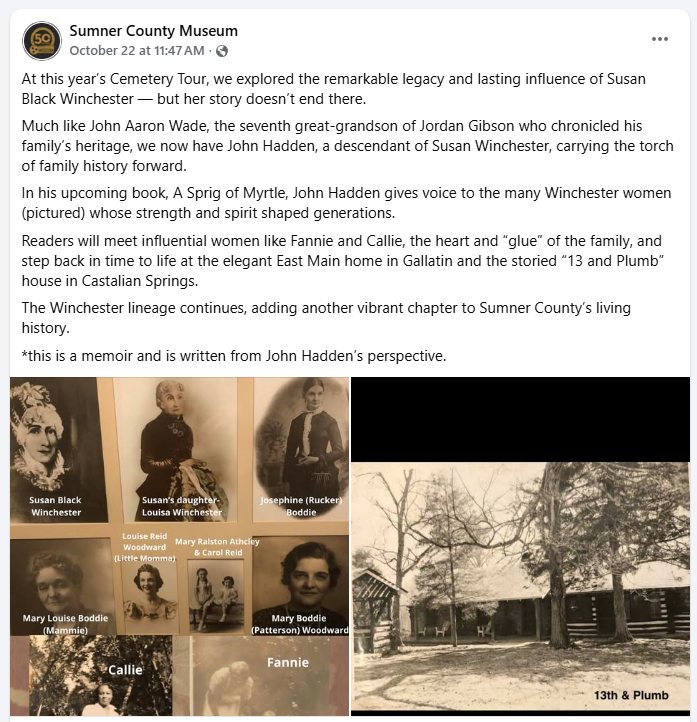
Momma, at 84 years old, may just very well be the closest living connection to the Antebellum South. I know lots of people grew up in the 1940-50s in the South. And even that time period is a good eighty years removed from the Civil War. But momma grew up with her grandparents, on the farm she affectionately calls “13th and Plumb,” as in 13 miles out and plumb in the country along the Cumberland River in Sumner County. It can get confusing, but her “Daddy,” so called, was her granddaddy, Dr. Fred Ralston Woodward, a dentist who owned and drove in from 13th and Plumb to his office in Gallatin, Tennessee. He had brothers John Woodward, a Nashville banker for whom I was named, and Felix G. Woodward, the Dean at Austin Peay State University for whom the school library is named. These three’s mother was known to be a strict Presbyterian that administered the Sunday School, and word has it that the letter of the law may have caused the pendulum to swing away from church-going for the firstborn son. Rather, Dr. Fred Ralston Woodward was “living the life.” HIs brother John would bring his banker friends out to the farm on the river for parties annually. They were not exactly the frozen chosen.
My Momma’s “Momma” was her grandmother, Mary Boddie (Patterson) Woodward, called “Muh-rie” (b. 1897). She was Dr. Fred Woodward’s wife. They raised my mother out at 13th and Plumb. Well, with a lot of help. Like Callie and Cassie and Fannie and Nora. Any Southern slice of Americana necessarily features race relations. The pessimistic reflection will dismiss it all with Uncle Tom’s Cabin. But my mother quivers with sincerity to speak of Callie and Cassie and Fannie and Rucker and others as family. Callie seems to have been a kind of anchor in the midst of turbulence. She began her day in town cooking and doing the heavy lifting at “Mamie’s” house with a beautiful flower garden in front, on the corner of East Main Street, an address that signified a measure of social status in Gallatin. This “Mamie” was Maria Louisa (Boddie) Patterson (b. 1859). She lived 98 years, the last thirty as an aging widow, until her death in 1957. She was “Muh-rie’s” momma. Not only was Callie an anchor, but she was also a link between town and country. That’s because when Callie finished up at East Main, she was driven out to 13th and Plumb to help “Muh-rie,” my momma’s “momma.” All the Marys and Mommas can start to run together like the watercolors of a child’s finger paint. Here’s the streamlined summary: my mother Mary was raised by her grandmother Muh-rie, whose mother Mamie was born before the first shot fired at Fort Sumter started the Civil War. And Callie took care of all of them. They needed a lot of help. At first Callie was helping at both locations. When Callie left East Main Street during the day for 13th and Plumb, that’s when Cassie would come in as the night nurse for Mamie at East Main.
The East Main house became kind of the in town headquarters for mom and ’em as she grew into her teens. On Fridays, she wanted to stay in town late so as to be down in amongst the action. Boys and all that. Momma and her best friend Ginger used to stay at Mamie’s on the weekends and some summer nights too. Cassie was the sitter. They liked to go up late to the Triangle around 11:00 at night to get hamburgers. Cassie would walk them up there; they were scared to go alone. But Cassie didn’t cross the street. Segregation and all that. Ginger lived in town and was well-connected with a large Methodist youth group. She told Mar-austin (that’s how Mary Ralston, my mother’s name, is pronounced) about a new family, the Haddens, that just moved to Gallatin with three cute boys. One of those sleepover nights at East Main, Joe Lee was delivering groceries to the house next door in a 1950 Blue Two-Tone Buick. Ginger pointed him out, and Mar-austin put her knee up in the bay window and laid eyes on Joe Lee for the first time. If the bay window was the vista for scoping out the man of her dreams on that night, it was another night when spiritual forces of darkness pierced from the outside in. A nightmare that still haunts momma today. Across the street on East Main lived a woman who didn’t exactly maintain the street’s reputation of upstanding, monied white folks. Or maybe she embodied its emptiness in a strange way. On drugs. Crazy. Known to walk up and down East Main as a “Peeping Tom.” Late one sleepover night, darkness set in. An unseen element disturbed her peace and beckoned a glance. The face of the crazy woman pressed against the window pane with eyes big and round, like saucers. Staring. A nightmare difficult to un-see. Cassie helped, but the damage was done.
Like most kids, I was still needing rides home myself at fourteen years old, but Momma was at the wheel giving rides at fourteen. She learned to drive at a young age out on the farm, and with all the back and forth, they needed help with the help. Another would-be driver of age may have been channeling Tam O Shanter at the nappy, getting fou and unco happy. So Dr. Woodward petitioned for Mar-austin to have a driver’s permit at fourteen. And I have to assume this allowed her to get where the action was on occasion. But eventually, Mamie aged to the point Dr. Woodward and Muh-rie had to bring her out to the farm. The house on East Main was leased as three apartments and the corner as a service station. So around 1955, at 13th and Plumb, along the banks of the Cumberland River lived my mother Mar-austin, Muh-rie, and Mamie, who was born in 1859. That’s why I say my mother just may be the closest living link to the Antebellum South still with us today; at least to he-ah huh reminisce, to tell stories with an authentic Southern Soft-R Accent is better than Google. And Mamie was a living link to her great grandmother, Susan Black Winchester, who, from the Grandeur on the Frontier, broadens widely the historical context in order to ask: where have we come from, and where are we going?
My wife Linda and I drove up to the homestead built by my fifth great grandfather. That’s seven generations back from me. The shadows were getting long and we were the only ones there, except for the tour guide and his wife, who had just locked up for the day and were leaving. He was friendly and apologized as if we could come back another time. No worries, I said, just wanted to show Linda a bit of my heritage. The host perked up, discerning I was a descendant, although his wife didn’t seem too impressed. Like, here we go again, he’s giving one of the special tours to family. And so we learned of the craftsmen traveling 700 miles from Baltimore who built Cragfont, the Georgian Grandeur on the Tennessee Frontier; of urns made by Dave the potter; of authentic cherry antiques, T-shaped architecture reinforced with iron beams; of the first Tennessee ballroom where the Winchesters entertained frontiersmen like Sam Houston, Andrew Jackson, and John Overton; of original stencil on the walls and the dollhouse; and of beautiful gardens. And…of ghost stories.
In fact, as we left a cast and crew for a darkly-themed movie had arrived to scope out the scene they would soon be shooting. It seemed Cragfont was well-suited for such mystery. And I began to wonder if the saucer-like eyes that disturbed the peace of a young adolescent girl down the road on East Main in Gallatin, six generations removed, had some strange connection to the first family of Cragfont, recalling the vision of an urn-like ephah going forth, arousing the ancient prophet Zechariah, who heard an angel tell what it is: “This is Wickedness!” And he thrust her into the middle of the ephah and threw the lead weight on its opening. Then I raised my eyes and looked, and there two women were coming out with the wind in their wings; and they had wings like the wings of the stork, and they lifted up the ephah between the earth and the heavens. So I said to the angel who was speaking with me, “Where are they taking the ephah?” Then he said to me, “To build a temple for her in the land of Shinar; and when it is prepared, she will be set there on her own pedestal.”
General James Winchester took Susannah, shortened to Susan, into the marriage bed as it were in 1792. James was 40 years old; Susannah was 15. Way out on the frontier, Bledsoe’s Lick to be more precise, ministers were aplenty, but James moved slowly with respect to formalities. The marriage would later be ratified five years after Tennessee obtained statehood; this legality also recognized the earliest of their children. Nonetheless, their union embraced the essence of the created order, the two shall become one flesh, and with fourteen children, they definitely took to heart: be fruitful and multiply. But how a young virgin caught the eye of a forty year old Revolutionary War private-then-lieutenant-then-captain may be left to the imagination, and a little biology, I suppose. Weary from fighting and being captured and released in prisoner exchanges twice, James no doubt found Susannah a soft spot for sore eyes. This soldier had battles to fight, an adventure to live, and a beauty to rescue.
Following the war, with land and over $2,000 in compensation for service, James and his brother George set out from Maryland, where their father, William Winchester, had arrived as a twenty year old indentured servant in 1731. William had voluntarily bonded himself, perhaps sensing an adventurous opportunity, for five years of service on His Majesties Maryland Plantation. Upon completion of the debenture, William settled into farming, founded the town of Westminster, and even helped to erect its first church building, a log cabin structure open to all denominations. He married Lydia Richards, whose father was one of the Quaker founders of a community along the Patapsco-Conewago Road in Carroll County, Maryland. The trajectory of William Winchester’s military service in the French and Indian War in 1757 as well as his efforts in the revolutionary movement stand in bold relief to the posture of the Quakers, if his father-in-law may be used to capture this current in American history that stems at least from 1660, when a group of religious seekers led by George Fox formulated The Peace Testimony before King Charles II: “We utterly deny all outward wars and strife and fighting with outward weapons for any end or under any pretense whatsoever. This is our testimony to the world.” Quaker was a derisive label assigned by outsiders describing the trembling characteristic of the sect’s worship, which is highly experiential, where the “Children of Light” and “Publishers of Truth” are inwardly illuminated, can hear and be led by the Spirit. In 1683, George Fox, the leader of the Religious Society of Friends, a somewhat official designation, enjoined upon the faithful: “God who made all pours out His Spirit upon all men and women in the world in the days of His New Covenant; yea, upon whites and blacks, Moors and Turks, and Indians, Christians, Jews, and Gentiles, that all with the Spirit of God might know God and the things of God and serve and worship in spirit and truth. Be patterns. Be examples in all countries, places, islands, nations, wherever you come that your courage and life may preach among all sorts of people. And, to them, then you will come to walk cheerfully over the world, answering that of God in everyone.” These Quaker ideals emerge in pacifist conscientious objection to war, social activism, a counter-cultural focus on the marginalized and disenfranchised, to be radically fair, embracing the “that of God in everyone” component of equality as they see it. Whether or not, and how, Lydia may have brought this paternal influence to her marriage with William, and then to her son James, is anyone’s guess; perhaps she left the suds in the bucket and the clothes hanging out on the line and eschewed Quakerism altogether. But the cross currents of the American frontier included spiritual fervor, anguishing questions, and ideals that would be tested by reality, creating rapids where the waters were alive.
In 1785, James Winchester and his brother George ventured to Bledsoe’s Lick, undertaking the construction of Fort Tuckahoe. Also called Winchester’s Fort, the settlement included a gristmill, sawmill, distillery, and a cabin; the fort provided a measure of protection against Indian raids for a few families at the fort.
The name for Winchester’s Fort curiously pointed to a contrast from most of the settlers, the poorer Cohee, who were typically of Scots-Irish descent. These Cohee were not landed gentry. Tuckahoe, the name of the Winchester’s Fort, was a slang term used on the frontier to describe settlers who came from a background of wealth, slave owning, land owning in and around the Virginia Piedmont. So Tuckahoe and Cohee betrayed the presence of the proverbial haves and have nots, even if the frontier provided opportunities to cultivate a sprig of myrtle.
And the Cohee, if not landed gentry, did share in common with General Winchester battle scars from the revolution and skirmishes with Indians. Elisha Hadden emerged from west of the Piedmont region, over in Rockbridge County, Virginia of the Blue Ridge Mountains. At seventeen years old, he enlisted as a Private soldier in a volunteer militia that marched to Greenbrier and pursued Shawnee Indians across the Gawley Mountain, then later guarded Green County, North Carolina against the Cherokee. Elisha, later drafted into a company under the command of John Sevier, marched to Kings Mountain, where he battled the British and the Tories. Then near the age of thirty, Elisha was one of 32 men along the Tennessee River surrounded by some 450 Cherokees. The soldiers were drawn into the river; half were killed, and five wounded. Elisha Hadden was taken prisoner with a leg broken by a rifle ball and shots taken in his left arm and shoulder. Elisha’s brother rescued him, and they escaped to a fort before Elisha was taken home in a litter. None of these battle scars warranted payment. Whereas the Tuckahoe General James Winchester received $2,000 following the war, settling with his brother George in Sumner County, Elisha was carried by his brother in a litter. Following time for healing, this Cohee scrapped his way to Western Kentucky. At the age of 73, hearing that Congress acted to extend pensions to veterans of the Revolutionary War, Elisha Hadden traveled to the District Court in Illinois to apply for the pension. It was denied on the grounds that a pension only applied to organized military service. The fine print, the lying pen of the scribes, to borrow a phrase from the prophet Jeremiah, has a way of weaseling around things.
And the Haddens of the Cohee were not astute with fine print. So much so that even various spellings of their name emerged. Hadden, Haden, Haddon, Hedden. Shedden could easily arise from parsing a name like Elisha Hadden into Eli Shedden. Of course, such fluidity is inherent in language itself and is not unique to the Haddens. So when courthouse records of the early 19th century indicate that Elijah Haden built a store, establishing Old Hadensville, wild speculation is not needed to conclude that just maybe a battle-scarred soldier once tried his hand at retail. After all, many a Sunday School teacher has crossed up the prophet Elijah and his doubled-unction prodẻgẻ Elisha, have they not? Whatever the case, the store didn’t get franchised, nor is Old Hadensville anymore than a passing reference in an old courthouse record. But a whole slew of Haddens, farmers and such, would proliferate in Todd County, Kentucky.
If Elisha Hadden was rejected as a pensioner, quite the opposite was the case for General James Winchester. He was admitted to the Society of the Cincinnati, an elite fraternal hereditary society that began with officers in the Continental Army. The formation of such an organization at least raised the question of whether the same entrapments of the nobility in Europe were crystalizing in the new nation. Benjamin Franklin addressed the issue of heredity honor embraced by the society in a letter to his daughter, although he may have been intending his criticism to poke at the soft underbelly of Europe.
“For honour, worthily obtained, as that for example of our officers, is in its nature a personal thing, and incommunicable to any but those who had some share in obtaining it. Thus among the Chinese, the most antient, and from long experience the wisest of nations, honour does not descend, but ascends. If a man from his learning, his wisdom, or his valour, is promoted by the emperor to the rank of Mandarin, his parents are immediately entitled to all the same ceremonies of respect from the people, that are established as due to the Mandarin himself; on the supposition that it must have been owing to the education, instruction and good example afforded him by his parents, that he was rendered capable of serving the public. This ascending honour is therefore useful to the state, as it encourages parents to give their children a good and virtuous education. But the descending honour, to a posterity who could have no share in obtaining it, is not only groundless and absurd, but often hurtful to that posterity, since it is apt to make them proud, disdaining to be employed in useful arts, and thence falling into poverty, and all the meannesses, servility and wretchedness attending it; which is the present case with much of what is called the Noblesse in Europe. Or if, to keep up the dignity of the family, estates are entailed entire on the eldest male heir, another pest to industry and improvement of the country is introduced, which will be followed by all the odious mixture of pride, and beggary, and idleness, that have half depopulated and decultivated Spain; occasioning continual extinction of families by the discouragements of marriage, and neglect in the improvement of estates. I wish, therefore that the Cincinnati if they must go on with their project, would direct the badges of their order to be worn by their fathers and mothers, instead of handing them down to their children. It would be a good precedent and might have good effects. It would also be a kind of obedience to the fourth (sic) commandment, in which God enjoins us to honour our father and mother, but has nowhere directed us to honour our children. And certainly no mode of honouring those immediate authors of our being can be more effectual, than that of doing praise worthy actions, which reflect honor on those who gave us our education; or more becoming than that of manifesting by some public expression or token, that it is to their instruction and example we ascribe the merit of those actions.”
As one “educated beyond my intelligence,” and that on account of my parents, I would affirm the appeal to obey the fifth commandment. But Franklin’s dismissal of the firstborn son as a steward of heritage overlooks a major theme enjoined by scripture. Perhaps sons of the Enlightenment like Benjamin Franklin were not inclined to appeal to scripture as an authority, though they certainly referenced it in a curated kind of way. Parents who receive an ascending honor are hoping very much to pass along a descending legacy. So maybe this tension is better embraced as a both-and rather than an either-or. And it matters not whether the station is the grandeur of a fiefdom on the frontier for General James Winchester or more like a farming family for Elisha Hadden. The fifth commandment applies. Honor your father and mother so that it may go well with you on the earth.
Before the bluegrass state to the north became the thoroughbred capital, the frontier around Cragfont was foremost in horse racing in the first half of the 18th century. Dr. Redmond Dillon Barry brought race horses and bluegrass, which grew well in the presence of limestone. Racing was the thing. Even a Methodist Minister enjoyed the pursuit of the Silver Cage urn-like trophies, much to the consternation to his wife. He “went in halfers” on the ownership of a racer. When she complained about her man of God going to the races, he snorted that the other person owned the front end of the horse and he owned the back end, and he couldn’t keep his end from running in the race. Seemed like a nice work around. Seek forgiveness rather than permission.
At the same time that Winchester was planning Cairo, the upstart community near Cragfont, he was also investing in Memphis along with his friends and business partners, Andrew Jackson and John Overton. Overton and Winchester would remain invested in Memphis over the years and Winchester’s first son Marcus Winchester served as the first mayor of Memphis. Winchester passed away before seeing Memphis become a success. Mayor Marcus Brutus Winchester eventually moved outside the city as race relations became more significant with the growth of the population. His marriage to Maria Louise Amarante Loiselle, a woman of color, was not received well by an emerging bourgeoisie. Evidently Marcus did not have a predilection for the new covenant enforced by Ezra and Nehemiah, who were in charge of a remnant returning to Jerusalem from Babylon, the land of Shinar, hoping to rebuild Jehovah’s temple, some 2,400 years earlier. That’s when the chosen people were forbidden marriage to women from the goyim, the nations. Sent some packing like Hagar. Any application of this stricture, even in a new context, did not govern Marcus’ pursuit of a princess consort. Of course, Marcus was not the lone practitioner of miscegenation, whether with a concubine, a mistress, or a wife. For instance, Gideon Gibson’s family first appeared in the records when they applied for land in the Santee River area in South Carolina around 1730. Although some objected to there being “free colored men with their white wives,” in the end they were given permission by Governor Robert Johnson, who met with Gideon and found him to be an impressive man of means, owning slaves himself. One of Gideon’s sons, Jordan Gibson, moved with the family to the Pee Dee River area of South Carolina as a young child, defended Charleston in the Revolutionary War, but later, in 1782, “went to the West with Daniel Boone,” as has been handed down orally. The Daniel Boone folklore may better be rendered, “he went to the West like Daniel Boone,” but, hey, there is history and there is sacred history. He received a 640 acre land grant in Davidson County, North Carolina, which later became Sumner County, Tennessee, from Colonel Anthony Bledsoe for his service defending Charleston. Though his father Gideon was a free mulatto who had a white wife, Jordan himself married a woman of color. They had four children, including “Widow Black,” Susannah’s mother. On the fateful night of January 17, 1788, Jordan was ambushed, shot and killed by a band of Cherokee near the home of Major William Hall, Sr, whose son, Governor William Hall, Jr., recounted the scalping in his memoirs around 1852, recalling that the slain Jordan Gibson left behind no white family members. So perhaps the Mayor’s wife Maria Louise was not the only reason for consternation on the banks of the Mississippi; perhaps his own heritage marginalized Marcus in Memphis as if Leviathan’s lyrics, there ain’t no demand for the man, could also be arranged in an agonizing Negro Spiritual.
Upon General James Winchester’s death in 1826, Susan cared for Cragfont as a child—and raising fourteen children at the homestead certainly provided the needed experience—riding out on her horse every morning to survey the land, where perhaps she heard the strains of folk songs that would later show up in minstrelsy. I’ve got a home in Baltimore, Lil’ Liza Jane, porch behind and porch before, Lil’ Liza Jane, come along honey and go with me, Lil’ Liza Jane, we can go to Tennessee, Lil’ Liza Jane. I’ve got a buggy and a horse, Lil’ Liza Jane, come along honey and be their boss, Lil’ Liza Jane.
Cragfont stood like a beacon on the road from Nashville to Baltimore. A landmark to weary travelers. Those with letters of introduction might stop for a night or two. Friends, acquaintances, and business associates were often at the home. Cragfont welcomed so many visitors that the family often remarked in their diaries and correspondence when a night passed without one. Governor Sam Houston needed no letters of introduction, but he was often a weary traveler: “I have as usual had ‘a small blow up.’ What the devil is the matter with the gals I can’t say but there has been hell to pay and no pitch hot!” General Sam Houston’s Liza, his first wife, would never be confused with the happy lyrics of Lil’ Liza Jane. No, Liza Allen was “The First Lady of a Foreign Country who never went there.” The wedding gown betrayed the wealth of Eliza Allen’s family; by all indications she would compliment the rising political career of Sam Houston. But the two never became one. A previous wound from an arrow near the place of intimacy dashed any hope that the young bride would be aroused enough to consummate the marriage. Rather, The First Lady of Tennessee was repulsed. Sam was forced to leave the state under the cloak of darkness, dressed like a woman on a steamboat to disguise his identity. He fled to the Indian lands of Arkansas and then on September 5, 1836 was elected President of the Republic of Texas. Not until April 8, 1837 did a judge back in Tennessee absolve Sam of his marital duties. Lil’ Liza Jane and Eliza Allen suggest an inverse proportion between social status and happiness.
Epilogue
I’ve unfolded my tripod, plucking the cat gut strings of the Takamine classical that daddy gave me for Christmas back in college days at Furman. Peaking in the sound hole reveals the model number with the assurance that this instrument was “crafted with conscience.” That means inner voice. The sun is setting on a pleasant summer evening overlooking the second oldest town in Tennessee, which is protected from the French Broad River by my perch, The Dike that Saved Dandridge. The dam is working, and that means the river is a lake this time of year. No dirt bikes on the muddy bottoms. Fishing vessels slice wakes through the glassy surface. English Mountain, sturdy as ever, is the backdrop to a new bridge, iron-posted with urn-shaped light cages on pedestals, joining the small hamlet to Appalachia, inviting walkers to stroll over heaven. No wonder people visit and settle here.
Passers-by smile. “Sounds good.” It’s not crowded. I wouldn’t be playing if it were. Usually dogs are on leashes. But one little lap warmer—he must be a country dog—is free to walk untethered. He knows his master’s voice and that seems to be enough. So he runs on ahead to sniff my feet.
“Here now…I’m sorry,” the elderly man with a belly eventually catches up and has no trouble barking instructions to his pet and simultaneously striking up a wee blether, all while maneuvering with his mouth a premium 9-inch cigar, hands free for gestures.
“It’s quite alright, he’s fine. It’s a perfect place to walk, and what a beautiful evening.”
“Yeah, if only people would pick up their dog’s mess. Just contrary, I guess.”
Just a flippant remark in passing. That’s all. The kind like, “But nobody cares about you, John.” Light badinage. Laugh it off, chuckle and roll with it. My freshman basketball coach kept walking. He didn’t recognize me. I suppose a salt and pepper beard concealed my identity and the echo in my head from forty-five years ago: Doc, you’re a good man. There’s just no demand anymore.
He shouldn’t have said those lying words. What to say instead, I’ve heard. From another voice. There’s a way to navigate through it all.
Doc, you’re a good man. There’s just no demand anymore: a false prophet.
I don’t subscribe to that point of view, but so many do.
https://www.facebook.com/share/p/1D2ovWwh4p
Hey, I’m John Shelby. Thanks for visiting my website. BroadRivers.com is my landing page with links for contact and support. Below is my Venmo link, and then there is a Pay Now button for other ways to support. I hope to encourage with songs and inspirational messages. Maybe we’ll get to meet in person at various venues. Below are links to my YouTube Channel, where you can find Live Streams and other videos.

No Venmo? Use the Pay Now Button for Cards:
https://www.youtube.com/@broadrivers

-
John Shelby Hadden
admin@broadrivers.com
232 Battlefield Drive
Dandridge, TN 37725
(423) 839-6739